#3 -- To Beep or Not to Beep


Title - To Beep or Not to Beep
Director - Chuck Jones
Released - 1963

Interesting Fact -- The only WEC/RR short to not feature their "Latin" names

Reason for Placement --

Ok, I've probably got some explaining to do.

This was one of the last WEC/RR shorts to be directed by Jones and his co-director Maurice Noble, and in my opinion, probably one of their best. Rather than opening in mid-chase, we start on Wile E. looking through a cookbook, only to be startled by the Road Runner. This is actually a great visual start to the chase, the viewer is given a real initiative as to why the coyote is going after this bird in the first place.

I'll go ahead and admit that To Beep or Not to Beep was easily my favorite cartoon when I was a kid. Not just one of the top 5 shorts, this was it. So what made this short so special to me? Plain and simple: the catapult sequence.

When it came to Wile E.'s traps and tricks, the coyote would try it once, it would backfire/blow up in his face, and he'd move onto the next idea. Not so in this short: he keeps trying and trying again with the same catapult, hoping that the next time he would be successful. After all, if at first you don't succeed, try and try again. But of course, for the poor coyote, it doesn't matter how many times he tries; the Fates have spelled it out nice and clear: NOT GONNA HAPPEN!

I'm sure I'll get some backlash on this one, but I guess I'm just about as stubborn as the coyote, because for me, To Beep or Not to Beep will remain one of the best Looney Tunes shorts of all time.

#4 -- One Froggy Evening


Title - One Froggy Evening
Director - Chuck Jones
Released - 1955

Interesting Fact -- Selected for preservation in the National Film Registry by the United States Library of Congress

Reason for Placement --

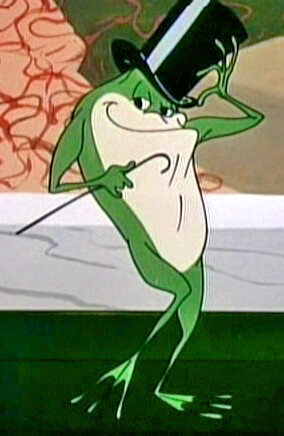
I know I've mentioned one-shot cartoon characters before on the countdown, but in the realm of Looney Tunes, there is no bigger one-hit-wonder than Michigan J. Frog and his debut toon, One Froggy Evening.

A construction worker comes across a black box containing a single frog, who dons a top hat and starts to sing! Thinking he has a chance at turning the frog into a quick profit, the worker takes the frog to a talent agent, and later rents out a theater for his performance, but runs into a small problem: the frog refuses to perform for anyone but the worker.

Critics and animators all over the world consider this short to be one of the greatest ever created; Steven Spielburg, at one point, called this short the "Citizen Kane of animated film." And despite only appearing in one short during the Golden Age of animation, Michigan J. Frog has gone on to become one of the most recognized characters in the business, and was featured as the mascot for the WB Network for 10 years.

Though some may not know it, Michigan did in fact make one more cartoon: 40 years after his debut, Jones released Another Froggy Evening into theaters, which shows various men through history (whom all bear a striking similar appearance to the worker in the original film) as they encounter our favorite singing amphibian... and all find out the same way just what happens when they try to get him to sing.

Either way, the shorts do teach us a valuable lesson: when you are blessed with a gift, treasure it for what it is, not what it could become.

#5 -- What's Opera, Doc?


Title - What's Opera, Doc?
Director - Chuck Jones
Released - 1957

Reason for Placement --

Where do I begin? What's Opera, Doc? is widely considered one of the best, if not the best, cartoon ever created. It was the first cartoon selected for preservation by the Library of Congress, was voted the #1 cartoon of all time by a selection of 1000 members of the animation field, and many consider it to be director Jones' greatest creation ever.

The story starts with a fast-paced chase between Elmer and Bugs, set amongst parodies of classic Wagner operas, with select parts of dialogue sung to well-known pieces (probably the most popular being Elmer's "Kill da Wabbit!" set to the Ride of the Valkyries).

The production behind this piece is nothing short of amazing. Whereas production units at Termite Terrace were only allowed to work on one specific cartoon for 5 weeks (to maximize the output of cartoons), Jones and his team doctored their timecards to read that they were working on Wile E. Coyote/Road Runner cartoons for an extra two weeks so they could continue working on this short. To help create the dance sequence between the characters, actual ballet dancers were studied to depict realistic movements. Maurice Noble's backgrounds are, as always, breathtaking, and the musical arrangements by Milt Franklin work incredibly well with Michael Maltese's dialogue.

And of course, even after you strip it down, you have the basic storyline that we all love: a classic chase between Elmer and Bugs (complete with Bugs in drag, of course).

While it didn't get the appreciation it deserved when it was first released (it was never nominated for an Oscar), What's Opera, Doc? remains one of the greatest pieces of animation ever created, a classic triumph of art and music that will continue to be loved by fans for years to come.

#6 -- The Hunting Trilogy


Title - Rabbit Fire, Rabbit Seasoning, and Duck! Rabbit! Duck!
Director - Chuck Jones
Released - 1951, 1952, 1953

Reason for Placement --

I know, I know, I'm technically cheating here, I'm sorry!! I know I established the rules, but try as I might, I just couldn't split these three cartoons up.

These three cartoons make up Jones' 'Hunting Trilogy', the three cartoons to feature Bugs, Daffy, and Elmer as they go up against one another during hunting season. All three have the same core plot line (in fact, the only major difference between them is that Duck! Rabbit! Duck! takes place during the winter, while the other two take place during the spring/summer & fall): Elmer is hunting in the woods, Daffy doesn't want him to find out that it's actually Duck Season, so he manages to trick the hunter into going after Bugs... which, of course, does not work out that well.

So what's so great about these shorts? Well, for starters, they were the first toons to really showcase a rivalry between Bugs and Daffy, and they were the first cartoons to feature Daffy's new catchphrase, "You're desthpicable!".

Taking them apart, each of these shorts gave us some of the most popular and famous jokes ever to come out of Termite Terrace. Whether it's Rabbit Seasoning's "Pronoun Trouble" scene, Duck! Rabbit! Duck!'s gag of pulling out new hunting season signs, or even the now infamous "Duck Season/Wabbit Season" scenes from Rabbit Fire, there's no denying that these are some of the most influential cartoons of all time.

Oh, and how could I forget! These were also the first shorts to showcase a new gag: every time Daffy got shot, his bill would fly off in a different style. Probably worth mentioning that this part was parodied in the opening scene of the movie Looney Tunes: Back In Action (and I want it on record that was probably the funniest part of the whole movie, not a good sign).

So we can debate for hours about which of these shorts was the best and whether or not I should have separated the three on the countdown (and whether it's Duck, Goat, Dirty Skunk, Mongoose, or even Baseball Season), but there is really no question that these are, without a doubt, three of the best Looney Tunes cartoons ever released.

#7 -- Operation: Rabbit


Title - Operation: Rabbit
Director - Chuck Jones
Released - 1952

Reason for Placement --

Wile E. Coyote had made his debut 3 years prior in the classic Fast and Furry-ous, and having proven himself such a great character and classic villain, it seemed only natural to have him go up against everyone's favorite wascally wabbit.

It's pretty debatable whether Wile E. makes a better foe for Bugs or the Road Runner, but I personally have always loved it when he went up against Bugs, not only because he could now talk, but Jones and Maltese really gave us a character to hate. Wile E. is so stuck-up and full of himself that we love it all the more when his traps misfire and he gets it in the end. During his first introduction to Bugs, he goes on a long (obviously prepared) speech about why Bugs won't stand a chance against him, and Bugs gives him a look that clearly says, "Buddy, you deserve everything you're going to get... and more." The more he gloats about being a genius, the more we love it when Bugs gives him his comeuppance.

While Wile E. would return to hunting the Road Runner later that year in his next cartoon, Beep Beep, and would not be paired with Bugs again until 1956's To Hare Is Human, there is no doubt that Operation: Rabbit is one of the coyote's (and Bugs') best shorts. Wile E. may be a super-genius, but it's clear from the start of this short that as smart as he may be, he never stood a chance against one well-prepared rabbit.

#8 -- Now Hear This


Title - Now Hear This
Director - Chuck Jones
Released - 1963

Interesting Fact -- Nominated for Academy Award in Best Short Subject, Cartoons

Reason for Placement --

This was the first Warner Bros. cartoon to use a brand new opening animation with a new abstract logo and modern rendition of "Merry Go-Round Broken Down". This alone should make it abundantly clear that what we're about to see is very VERY different.

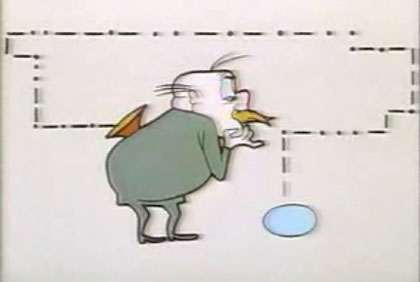
An elderly gentlemen comes across a brand new hearing horn, only to discover that by using it normal everyday sounds are magnetized and the man starts experiencing increasingly strange aural and visual hallucinations. It isn't until the end we see the cause of all his grief: the horn he found isn't a hearing horn, but is quite literally the devil's left horn!

Now Hear This is an amazing cartoon, not only because of its incredible animation, but also because of sound effects created by film editor Tregoweth "Treg" Brown. Unlike other non-dialogue cartoons, this short doesn't rely on music, but rather on Brown's outstanding sound effects. There are two parts of this short that use music created by Bill Lava, but the rest of the sound all belongs to Brown (any other music not supplied by Lava is stock music that Brown edited in). The randomness of the sound showcases real creativity and spontaneity: a single bug sounds like a train, an inquisitive look brings out the sound of morse code being tapped over a wire, a man's heartbeat sounds like a traffic jam, and in the climax, the animators give Brown a little help by putting the words "GIGANTIC EXPLOSION" on the screen, just to make sure we get the full emphasis of what's going on.

So while Jones and co-director Maurice Noble get the credit for this incredible creation, I've got to give credit where credit is due, and it's Brown's work with the sound effects that allows this cartoon to leave such an impact. Now Hear This is a great short that really grabs our attention, and we hear every little bit of it.

#9 -- High Note


Title - High Note
Director - Chuck Jones
Released - 1960

Interesting Fact -- Nominated for Academy Award for Best Short Subject, Cartoons

Reason for Placement --

This goes down as one of the most creative ideas ever put to pen and paper. A group of music notes come to life and create sheet music for the classic waltz, "The Blue Danube". However, one of the notes has stumbled into Joseph Winner's song "Little Brown Jug", has become intoxicated, and proceeds to run amok throughout the waltz, causing the conducting note to chase after him and get him back where he belongs in the song.

I've got to confess that, as an artist, this was probably the most inspirational cartoon I've ever seen; the idea of giving life to music notes and the way Jones and his team were able to create every-day objects out of musical symbols really helped jump-start my creativity and open my eyes to what could be done with art and animation.

I should also point out that when I got to junior high and joined the school band, I couldn't look at my sheet music without thinking of this cartoon. Some people might have just seen music notes, but for me, whole notes will always be eggs, sharps will always be tic-tac-toe boards, and quarter rests will always be dogs.

High Note, a classic cartoon that is, quite literally, music to everyone's eyes.

#10 -- Knighty Knight Bugs


Title - Knighty Knight Bugs
Director - Friz Freleng
Released - 1958

Interesting Fact -- May I have the envelope, please? Yes, ladies and gentlemen, I give you the only Bugs Bunny cartoon to ever win an Oscar.

Reason for Placement --

Using Freleng's usual method of placing our characters in historic locations, Bugs finds himself the court jester of King Arthur himself, who is looking for someone to retrieve his mystical Singing Sword from the Black Knight (played by everyone's favorite hot-tempered villain, Yosemite Sam). Bugs tells the King that, "Only a fool would go after the singing sword!" King Arthur's response: "A good idea... Fool!!" And so Bugs is sent to retrieve the sword from the Black Knight and his fire-breathing dragon.

Freleng and writer Warren Foster really outdid themselves with this masterpiece, it's probably one of the most well-written toons to come out of Warner Bros. The visual gags here are plenty, but the one-liners that Bugs and Sam throw back at one another give this short a real life that most other cartoons never got close to touching. It really all goes back to Freleng's remarkable sense of timing: it wasn't just with music and sound effects, it applied to the character's lines as well.

It's also probably worth mentioning that the Oscar for this short was a major plot-point in an episode of Tiny Toon Adventures, titled, "Who Bopped Bugs Bunny?" In the episode, Bugs is kidnapped by a jealous rival, Slap-Happy Stanley the Elephant, whose cartoon he beat out for the Academy Award. While Stanley was never seen outside this short, it does parody another cartoon, Terrytoon's Sidney's Family Tree (staring Sidney the Elephant), which was indeed nominated the same year as Knighty Knight Bugs.

#11 -- Show Biz Bugs


Title - Show Biz Bugs
Director - Friz Freleng
Released - 1957

Reason for Placement --

It's well known that of all the great pairings/rivalries in Looney Tunes history, none stick out so much like the classic combination of Bugs vs. Daffy. The pair worked so well together on the screen, it's no surprise that the two are still considered the mascots of Warner Bros. animation. Show Biz Bugs was a great short that really put the rivalry between the two characters into the spotlight and showed us just why Daffy hates the long-eared rabbit so much.

The toon starts with our main characters preparing to do a show together at a theatre. Daffy is determined to prove that he's the star of the show, but no matter what he does, he just can't get any respect (or applause for that matter) from the audience. This is the start of one of the longest gags in this pairing: all Bugs has to do is show up on stage, smile, and the audience goes nuts; Daffy pulls out all the stops in his singing and dancing, but all we hear are crickets. But this is what really fuels Daffy's jealousy: he's not just arrogant and competitive, he really wants to get his due on the stage, and we can all identify with that. It's not just about wanting to be on top... it's about wanting to be noticed in the first place.

Personally, I don't think I'll ever fully understand why Daffy never gets a hint of applause from the audience, but in reality, I don't really want to know. Part of the fun is knowing that no matter what Daffy does, no matter how hard he tries, he's always going to come in second place... that is, until the last gag in the show.

Daffy decides to whip out his biggest act, dresses in a devil costume, and literally drinks a number of flamable liquids, swallows a match, and EXPLODES! (And yes, this scene has been edited countless times for broadcast, Lord knows parents can't have their kids thinking it's cool to drink gasoline and nitro glycerin). Well, the act is a success and Daffy finally gets the applause he wanted so badly... it's too bad that he can only do the act once.

#12 -- Porky in Wackyland


Title - Porky in Wackyland
Director - Bob Clampett
Released - 1938

Interesting Fact -- Selected for preservation in the National Film Registry by the United States Library of Congress

Reason for Placement --

If you took the images of movies made by David Lynch, Terry Gilliam, and add Salvador Dali to taste... you'd have a tenth of the surrealism featured in Clampett's early opus, Porky in Wackyland.

This cartoon is like an acid trip, it is so bizarre. Porky goes on an expedition to find the long-thought extinct Dodo Bird, finding him in Wackyland (which is apparently located in the darkest regions of Africa). As the sign on the entrance explains, "IT CAN HAPPEN HERE"... and it pretty much does. I really wish I could explain half of the stuff Porky runs into, but frankly, it's all so abstract and strange that I honestly don't think I could do it justice. That's how crazy it all is. The design of this cartoon brings to mind one of those nightmares you had but refused to tell anyone about it because you were scared they'd think you'd lost your mind.

Also, this is one of the few cartoons that was pretty much remade in later years. In 1949, Friz Freleng oversaw a new version of the cartoon in full color, re-titled Dough for the Do-Do. The two films are nearly identical, though there are a few changes: a couple of gags are cut and a few new ones are put in, the voices are slightly different, and most of the backgrounds are altered just a bit.

Still, despite being so unbelievably bizarre, this cartoon really helped pave the way for Clampett's career with Warner Bros., and was a major jumping point for Termite Terrace to distance themselves from their Disney rivals. The plain & simple truth is that despite its updated remake from Freleng, there really was no other cartoon like Porky in Wackyland, and honestly, I don't think there will ever be another one like it.

Porky in Wackyland, a heavy-dose of eye-popping surrealism that serves as a reminder that no matter where we end up in life... at least it's not there.

#13 -- Birds Anonymous


Title - Birds Anonymous
Director - Friz Freleng
Released - 1957

Interesting Fact -- Won the Academy Award for Best Animated Short Subject

Reason for Placement --

Ask any die-hard Looney Tunes fan, and they'll tell you in a heartbeat that Birds Anonymous is an essential part of their collection. And it's not just the fact that it's one of the five Termite Terrace creations to win an Oscar.

First of all, this short parodies what is actually a rather adult topic: addiction. Alcoholics Anonymous wasn't a new program, but it wasn't until around this time that the general public really knew about it. In Birds Anonymous, Sylvester is invited to join the group of said name, in hopes that he will stop chasing Tweety (one cat at the meeting mentions that he joined B.A. after his addiction cost him five homes, but as Granny doesn't make an appearance in this short, it's hard to think about whether or not Sylvester would lose his happy home). So yeah, it's pretty obvious that for Sylvester, his obsession with Tweety is not one that can be so easily kicked.

There's also the fact that Mel Blanc himself said that this was his favorite toon to do voices for. Not all that surprising, the short features what could easily be considered a powerhouse performance by Sylvester, especially as he tries to fight off his addiction. Near the end, Sylvester finally breaks down and starts throwing a tantrum on the floor. Even though it's animated, we can actually feel the cat's frustration and depression as he falls victim to his desire for birds, sobbing and pounding the floor with his fists.

It's also worth mentioning that this was the only short that Blanc actually got an Oscar for: when Eddie Selzer (producer for Termite Terrace) passed away, he bequeathed the statuette to Blanc (in the "Behind the Tunes" on the Golden Collection Vol. 3, it's mentioned that Selzer promised Blanc he would get him an Oscar for his performance).

And, of course, there's the moral that Tweety gives at the end:

"Once a bad ol' puddy tat, ALWAYS a bad ol' puddy tat!"

**I'd like to apologize to my readers for taking so long to get back to the list, I am currently trying to start my own business, and had my hands full this month. Again, I'm sorry.

#14 -- Gee Whiz-z-z-z-z-z-z


Title - Gee Whiz-z-z-z-z-z-z
Director - Chuck Jones
Released - 1956

Interesting Fact -- Last cartoon where Jones credited himself as "Charles M. Jones".

Reason for Placement --

Ladies and Gentlemen, I give you what is probably one of the quintessential Wile E. Coyote/Road Runner cartoons. This was the 8th toon featuring this classic pair, but it contains some of the most memorable visual gags ever featured in the Looney Tunes.

So, let's get right down to it and look at the gags that help make this such a great cartoon. For me, there are two moments that help Gee Whiz-z-z-z-z-z-z really stand out. In the first one, Wile E. orders a Bat-Man suit that will allow him to fly after the Road Runner (no, not DC's Batman, this is a green suit with bat wings [see above photo], no Christian Bale jokes necessary). He spreads his wings all menacing-like, dives off the cliff... and starts plummeting to the ground. But instead of splatting as usual, Wile E. actually gains control at the last minute and start soaring! We see Wile E. flying, smiling proudly (no music in the background, just great sound effects provided by Treg Brown), it looks like he's really got the hang of the suit, and... WHAM! Right into the cliffside! And NOW we get the scene of him falling and splatting on the ground. Great build-up with even better pay-off, this is easily one of the greatest moments ever in WEC/RR history.

The second is the last gag: Wile E. straps a pair of handlebars on a jet engine and uses it to zoom after the Road Runner (accompanied by everyone's favorite Raymond Scott selection, "Powerhouse"). However, as the Road Runner nears the edge of a cliff, he does a U-turn, and Wile E. zips right past him, off the cliff! But he doesn't fall, and the engine keeps going with the coyote onboard, completely unaware that he's gone off the road. Disgruntled at having lost his dinner, Wile E. turns off the engine to think, still in mid-air, just inches away from the other cliffside. The Road Runner (who made it to the other end of the cliff), beeps to alert his foe of what is going on. Wile E. then violates the #1 cartoon law of physics: when defying the law of gravity... NEVER LOOK DOWN!

As he falls to his doom (yet again), Wile E. hold up a sign asking the director to end the cartoon before he hits. Jones is apparently willing to grant the coyote his last wish and irises out, but not before Wile E. can hold up another sign, thanking the animators.

#15 -- The Scarlet Pumpernickel


Title - The Scarlet Pumpernickel
Director - Chuck Jones
Released - 1950

Interesting Fact -- Voted #31 of the 50 Greatest Cartoons of all time by members of the animation field in 1994

Reason for Placement --

Who would have thought even cartoon characters get tired of being comedians? In this short, Daffy begs his boss to let him do a dramatic part, and reads to him a script that he wrote, "The Scarlet Pumpernickel". This was a major change for Daffy, as we see him in this new role as a masked bandit, channeling his own version of Errol Flynn as he saves his lady love, Melissa from the tyranny of... Sylvester and Porky. Yep, they're the villains in this one.

The Scarlet Pumpernickel is one of those cartoons that is not only fun to watch, but has so many interesting little details. First of all, this short has one of the biggest casts of Looney Tunes stars: you have Daffy, Sylvester, Porky, and even Elmer Fudd and Henery Hawk make cameo appearances. Second, this was only one of a few shorts that had numerous references to its birthplace, Warner Bros. Studios (Daffy even holds a conversation with co-founder Jack Warner, who remains off-screen and is referred to as J.L.). Also, there's the fun fact that as Mel Blanc used the same voice for Daffy and Sylvester (Daffy's voice was sped-up to give him a higher pitch), so the scenes of them together is essentially Blanc talking to himself... in the same voice!

And finally, you have what is probably the most controversial ending ever in a Looney Tunes short: after he finished plugging his script to J.L., Daffy pulls himself up, completely exhausted, and says, "...there was nothing left for the Scarlet Pumpernickel to do, but blow his brains out... which he did."

BANG!

"It's getting so you have to kill yourself to sell a story around here!"

#16 -- Rabbit of Seville


Title - Rabbit of Seville
Director - Chuck Jones
Released - 1950

Interesting Fact -- Voted #20 of the 50 Greatest Cartoons of all time by members of the animation field in 1994

Reason for Placement --

It's Rabbit Season again, and Bugs is on the run from Elmer, hiding out backstage at a large theater. However, as Elmer accidentally runs onstage looking for his prey, the curtain goes up, and Bugs and Elmer find themselves the stars of a new twist on the classic opera, The Barber of Seville.

While it goes without saying that Friz Freleng was the master of timing to music in Looney Tunes, the few music-based shorts that Jones directed truly stand out amongst some of the most memorable cartoons ever created. Carl Starling outdoes himself with this short, combining Rossini's brilliant opera with his own arraignments to help give the short an amazing musical score, punctuated with Elmer and Bugs' singing (interestingly enough, the two only sing through the first half, the rest is done without dialogue). The animation matches perfectly with each note; in fact, during the scene where Bugs "plays piano" on Elmer's head, Jones gives us the only animated sequence where Bugs is featured with five fingers to help match up with the hand of a piano player.

#17 -- Baby Bottleneck


Title - Baby Bottleneck
Director - Bob Clampett
Released - 1946

Reason for Placement --

Each of the Termite Terrace directors were known for having one particular trait that helped their toons to stand out: Friz Freleng was known for his timing, Bob McKimson had personality, and Chuck Jones was known for his style. Clampett, however, was known for his squash-and-stretch animation techniques which helped Warner Bros. to take the leap needed to disassociate themselves with Disney's animation department.

Baby Bottleneck is probably the best example of Clampett's animation. The Baby Boom had started, couples were all ready to start families, and Clampett played off of this by featuring what is literally a "baby factory": a facility designed to help get newborns to their expecting parents. Porky and Daffy are managing the factory, but run into some serious difficulty when they come across an unhatched egg with no address or name.

If you go frame by frame in this cartoon, you will actually see dozens of poses in each shot; the characters literally stretch themselves all over the screen, nothing is done in a simple blur shot. In one scene, Porky tries to force Daffy to sit on the unhatched egg, constantly pushing the duck across the screen and towards the egg. Just take a look at the screen shots and you'll see how much detail Clampett put into the animation.

It's also worth noting that the factory scenes include probably the most well-known use of "Powerhouse" by Raymond Scott, playing off the "assembly line"-style of the music with the babies as they are rolled out in the factory.